Zama is emerging as one of the most important infrastructure projects in the Execution Privacy segment, thanks to its ability to bring Fully Homomorphic Encryption into public blockchains. In the near future, ZAMA is preparing to enter its ICO and public sale phase, at a time when the project has already been valued very aggressively in previous funding rounds. This has sparked growing interest and debate around whether such a valuation is truly justified.
1. Overview of Zama
1.1 What Is Zama?
Zama is an infrastructure project focused on delivering high-grade privacy to public blockchains through Fully Homomorphic Encryption (FHE). The core breakthrough of FHE lies in its ability to allow smart contracts to execute directly on encrypted data without requiring decryption at any stage. As a result, user data remains protected throughout the entire computation process.
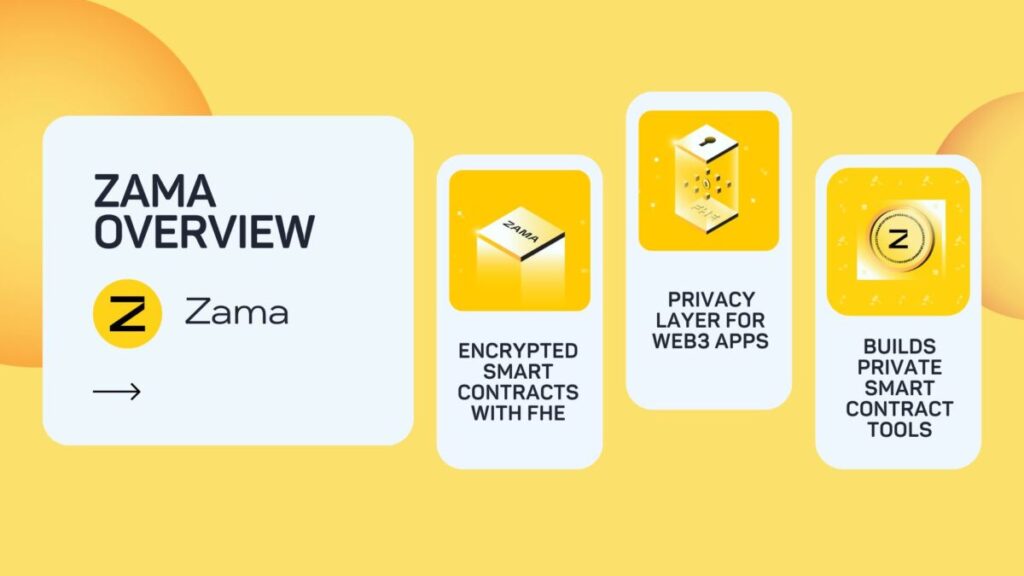
With this approach, Zama does not build a new Layer 1 or Layer 2. Instead, it functions as an additional security layer operating on top of existing networks. Tokens, smart contracts, and decentralized applications running on public blockchains can be upgraded into confidential versions without migrating to a new chain or relying on bridges.
Within Zama’s model, users continue to interact with familiar assets such as stablecoins, but in a fully encrypted form. Account balances, transaction histories, and transfer amounts remain private while still residing natively on the underlying network, such as Ethereum.
Beyond payments, DeFi protocols, NFTs, and RWA products can also adopt this security layer to conceal sensitive data without sacrificing verifiability or system integrity. Encryption and decryption processes are managed through an operator system combined with threshold MPC networks, ensuring robustness across multiple attack scenarios.
Overall, Zama represents a new direction for blockchain development. Rather than creating another chain, the project focuses on upgrading the security of existing infrastructure. If the vision of “HTTPS for blockchain” becomes reality, Zama could evolve into a standard infrastructure layer that a large share of onchain applications will depend on in the next phase of industry growth.
1.2 Team and Background
Zama has a team of 96 members, including approximately 37 PhDs from multiple countries, reflecting a very strong research and cryptography foundation.
Key contributors include:
- Rand Hindi, Co-Founder and CEO: With a background in computer science and a PhD in bioinformatics, Rand previously founded the AI and privacy startup Snips, which was later acquired by Sonos. He advocates a privacy-by-default philosophy and treats security as the core pillar of Zama.
- Pascal Paillier, Co-Founder and CTO: A renowned cryptographer and the inventor of the Paillier encryption scheme, Pascal plays a central role in developing Zama’s FHE technology.
- Jeremy Bradley-Silverio Donato, COO: Responsible for operations, ecosystem development, and the growth of the developer community.

As a whole, Zama’s team combines deep academic research with real-world execution experience, providing a solid foundation for its ambition to make FHE a standard privacy infrastructure for public blockchains.
1.3 Funding History
Zama has completed two private funding rounds, raising a total of approximately 130 million USD. The Series A round in March 2024 raised 73 million USD, followed by a Series B round in June 2025 that raised 57 million USD.
After the Series B, the valuation accepted by private investors stood at around 1 billion USD. This reflects strong market confidence in the long-term potential of FHE technology and Zama’s role as foundational infrastructure.
2. Operating Model
2.1 Core Technology: Fully Homomorphic Encryption
FHE is a cryptographic technology that enables computation directly on encrypted data. From input to smart contract logic and output, no decryption is required at any stage. This creates a true end-to-end security model with no intermediate points where data is exposed.
Compared to alternative approaches, FHE offers clear advantages. Zero-knowledge proofs only verify properties rather than processing full logic on encrypted data. MPC requires multiple participants, leading to higher costs and scalability challenges. Trusted Execution Environments rely on hardware and carry physical attack risks. FHE, by contrast, is purely cryptographic and does not depend on trusted hardware or third parties.
Historically, FHE was considered impractical due to extremely slow performance. Zama has achieved a major breakthrough by increasing throughput from 0.2 TPS to 20 TPS within five years, with a roadmap targeting hundreds to tens of thousands of TPS in the coming years.
In parallel, Zama has developed FHEVM, a complete framework for the EVM that allows developers to write confidential smart contracts using Solidity. This framework integrates an offchain coprocessor to optimize performance and cost. FHEVM is designed to be plug-and-play with the existing EVM ecosystem, supports multiple encrypted data types, and maintains stable gas costs, enabling confidential smart contracts that remain flexible and deployable.
2.2 Zama Protocol: A Security Layer for Public Blockchains
Zama Protocol is a cross-chain security layer designed to add confidentiality directly to existing public blockchains such as Ethereum, Arbitrum, Optimism, Base, Avalanche, and potentially Solana in the future. This approach brings privacy to blockchain systems without requiring new chains or forcing users to migrate assets.
Through Zama, tokens, NFTs, and smart contracts can all become confidential, with fully encrypted data. A key differentiator is programmable confidentiality, which allows developers to precisely define who can decrypt data and under what conditions. This makes Zama suitable for both individual users and institutions with strict data control requirements.
In terms of use cases, Zama unlocks several practical applications. In payments, stablecoins can become confidential stablecoins, addressing excessive transparency while remaining compatible with AML and KYC requirements. In DeFi, Zama mitigates MEV, front-running, and sandwich attacks, enabling private lending, DEXs, and AMMs without exposing trading positions. For RWAs, traditional assets such as bonds and equities can be traded onchain while keeping sensitive information private, creating a bridge between traditional finance and public blockchains.
3. Assessing ZAMA Ahead of TGE
In early 2026, ZAMA is expected to conduct its public token launch, marking the first time the token enters open-market price discovery. The sale consists of two components: an allocation for OG NFT holders and a public sale conducted via auction.
Two percent of the total ZAMA supply is reserved for OG NFT holders at a fixed price of 0.005 USD per token, corresponding to a valuation of approximately 55 million USD. There are around 5,500 OG NFTs, most of which were distributed through community and contribution programs. These OG NFTs are not collectibles but function as early access rights to purchase tokens at a lower valuation, positioned between private investors and public sale participants. OG NFT holders also receive a 5 percent bonus if they participate in the auction.
The public sale is conducted through a sealed-bid Dutch auction, open to all users without a whitelist. Participants submit their bid prices, after which the system determines the lowest clearing price that fully allocates the public token supply. All successful bidders pay the same clearing price, ensuring fair price discovery and reducing manipulation during the sale.
As a pioneer in privacy infrastructure using FHE, ZAMA’s valuation must be assessed in the context of comparable privacy-focused projects, most notably Zcash and Midnight.

Zcash was among the first privacy blockchains to implement zk-SNARKs, enabling shielded transactions while preserving validity. After more than eight years on mainnet, Zcash has continuously upgraded its technology through releases such as NU5 and Halo 2, removing trusted setup requirements and improving scalability. Today, Zcash is valued at approximately 8.3 billion USD in FDV. In contrast, ZAMA relies on FHE, a more radical but less battle-tested technology. While FHE enables computation on encrypted data, it remains in testnet stages and has not yet been proven at large scale, particularly in terms of cost and performance.
Midnight represents another approach to privacy infrastructure within the Cardano ecosystem. The project previously carried private valuations above 1 billion USD but has struggled to convince the market of short-term token demand. Its current FDV fluctuates around 1.75 billion USD.

Overall, ZAMA shares similarities with both Zcash and Midnight in entering public markets with a high private valuation and strong institutional backing. However, unlike Midnight, ZAMA extends beyond blockchain privacy into encrypted computation infrastructure with multi-chain potential. Compared to Zcash, ZAMA is more flexible and ambitious, but remains unproven at scale. As a result, public markets are likely to price ZAMA conservatively to reflect technical risk and the time required for widespread adoption.
4. Should Investors Participate in the ZAMA Public Sale?
4.1 Public Sale Mechanics
From January 12 to January 15, 2026, Zama will conduct the ZAMA public sale, with pre-registration opening on December 24, 2025. A total of 10 percent of the ZAMA supply is allocated to the public sale, with 100 percent of tokens unlocked at TGE.
The auction has a floor FDV of 55 million USD with no price ceiling and will take place on the official platform auction.zama.org.
The public sale uses a sealed-bid Dutch auction model powered by Zama’s own FHE technology, ensuring privacy and fairness. Participants must shield stablecoins such as USDC, USDT, or DAI on Ethereum to encrypt bidding information, while funds remain in the user’s wallet and are not locked.

During the auction, users can submit multiple bids with a minimum price of 0.005 USD per token. Bid prices are public, but bid quantities remain private and can be canceled at any time. After the auction ends, the system determines the clearing price, defined as the lowest price at which the full 10 percent allocation is sold. Bidders above the clearing price receive tokens at that price, with excess amounts refunded, while bids below the clearing price are unsuccessful. Tokens and refunds can be claimed on January 20, 2026.
4.2 Is Participation in the ZAMA Public Sale Advisable?
To answer this, the key risks must be considered.
The first risk stems from allocating 10 percent of total supply to the public sale in a market that remains sensitive to early profit-taking. With 100 percent of public sale tokens unlocked at TGE, price pressure could be significant immediately after listing, especially if liquidity is insufficient to absorb selling.
Second, while the sealed-bid Dutch auction is designed to be fair, the presence of FOMO or large bidders could push the clearing price higher. In that scenario, participants bidding aggressively to secure allocation may face downside risk, with limited short-term upside.
On the other hand, the Zama public sale has several attractive features. Capital lockup is relatively short, around seven days from auction start on January 12 to TGE on January 20. In a subdued market environment, reduced FOMO could result in a more reasonable clearing price, particularly given Zama’s strong financial position after raising 130 million USD from major funds.
As a result, a prudent strategy is to place bids at levels aligned with one’s own valuation expectations and market data such as pre-market signals, rather than chasing elevated clearing prices driven by hype. In such cases, risk often outweighs potential returns.
5. Conclusion
Zama introduces a fundamentally new approach to onchain privacy by applying FHE directly to public blockchains instead of creating a separate ecosystem. This allows user data to remain fully confidential while still being processed correctly, positioning Zama as an ideal solution for MEV-resistant DeFi, private payments, RWA trading, and institutional applications that require high levels of confidentiality.
Disclaimer: This content does not constitute investment, tax, legal, financial, or accounting advice. MEXC provides this information for educational purposes only. Always do your own research, understand the risks, and invest responsibly.
Join MEXC and Get up to $10,000 Bonus!
Sign Up