


I. MEXC TradFi Futures: A Quarter of Full-Scale Breakout
The total trading volume in Q1 reached new record highs for three consecutive months, with February surging 138% month-over-month and March delivering a further 45% increase. The volume curve showed sustained acceleration throughout the quarter. March 3 marked the single-day volume peak for the quarter, driven by sharp price swings across precious metals and crude oil. Throughout the extreme market conditions, MEXC TradFi maintained stable liquidity and fully absorbed users’ long and short demands.
User growth kept pace with trading activity. Monthly active traders grew 58% cumulatively over the quarter, attracting a large number of new users to complete their first TradFi Futures trade. As the user base expanded rapidly, engagement and retention strengthened in tandem.
On the product side, the number of TradFi Futures instruments grew 62% quarter-over-quarter, spanning precious metals, energy, US equities, global indices, forex, and ETFs — further broadening users’ access to traditional financial asset classes.
II. Market Drivers and Volume Structure: Precious Metals Account for Over 90%
The Q1 volume surge was the result of a two-way resonance between macro market conditions and MEXC‘s product positioning. Extreme moves in precious metals and energy generated intense trading demand, while MEXC TradFi’s rapid listing cadence, precise timing around key market inflection points, and the combination of zero trading fees, high leverage, and deep liquidity allowed users to participate seamlessly during the hottest trading windows.
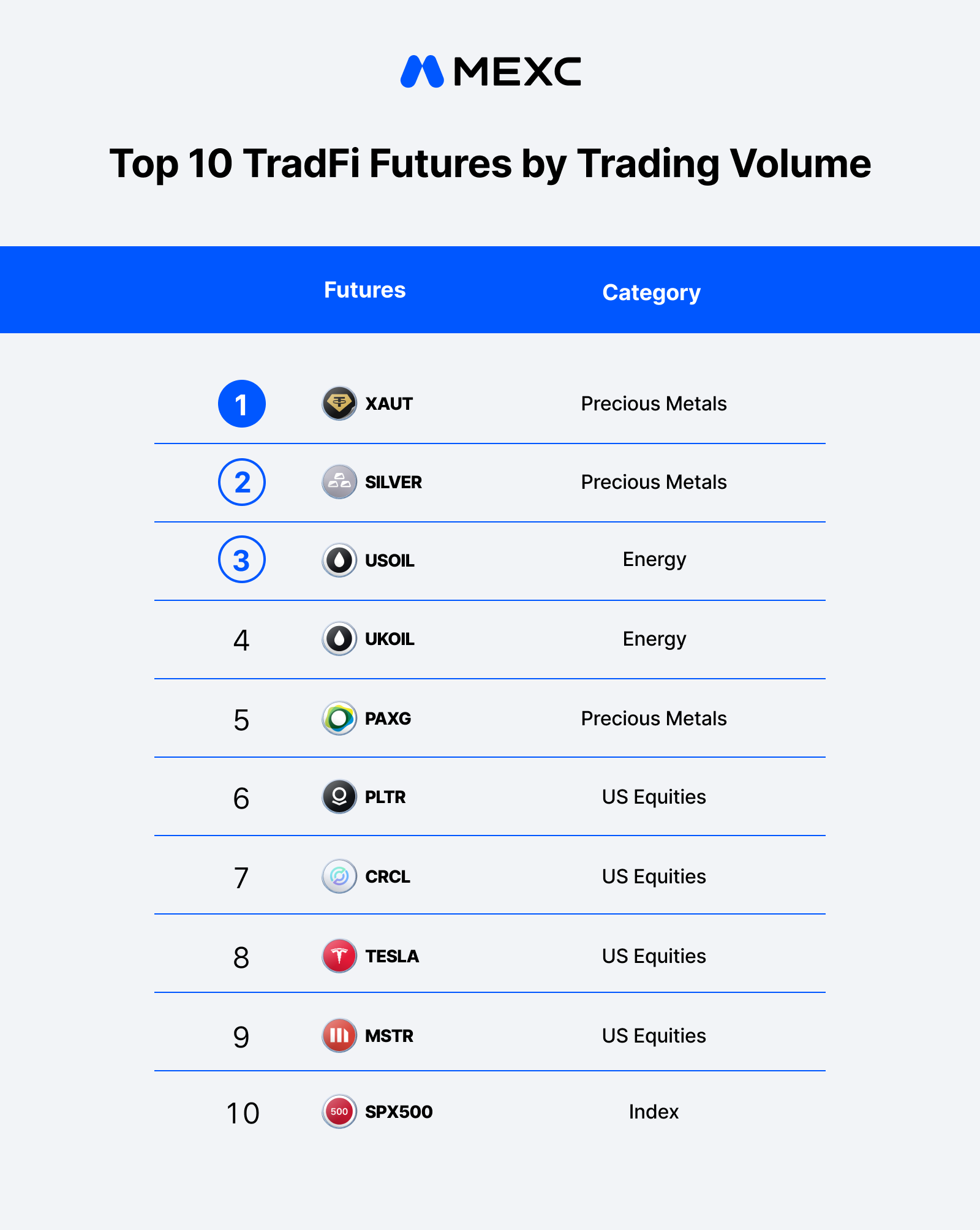
Among the Q1 Top 10, XAUT and SILVER ranked first and second, accounting for 71% and 22% of the combined trading volume of the top ten futures respectively — together covering over 90% of total volume. PAXG in fifth place further confirmed users’ strong preference for precious metal assets.
Energy was the standout new addition in Q1. USOIL (WTI) and UKOIL (Brent) launched on January 30, positioning MEXC ahead of a key inflection point in the crude oil market. Geopolitical tensions in the Middle East escalated sharply in late February, triggering significant price volatility and a rapid surge in market sentiment. Both instruments quickly absorbed demand and climbed to third and fourth place, establishing themselves as the core of the energy category.
In US equities, four of the top ten slots were taken by technology and innovation-themed instruments. Palantir (PLTR) ranked sixth, driven by the AI defense narrative; Circle (CRCL) entered at seventh on the back of stablecoin regulatory tailwinds; Tesla and MicroStrategy continued to attract steady trading volume through their natural alignment with the crypto community. While the US equities segment remains relatively small in scale, its thematic rotation is well-defined and its user base diverse, making it a meaningful growth vector within the TradFi Futures lineup. On the index side, the SPX500 futures also entered the Top 10, together with US equity instruments forming a complete picture of MEXC TradFi’s equity-linked product offering.
III. MEXC Leads in Precious Metals and Energy Market Share
From a competitive standpoint, MEXC TradFi has demonstrated a strong market presence across both the precious metals and energy futures segments.
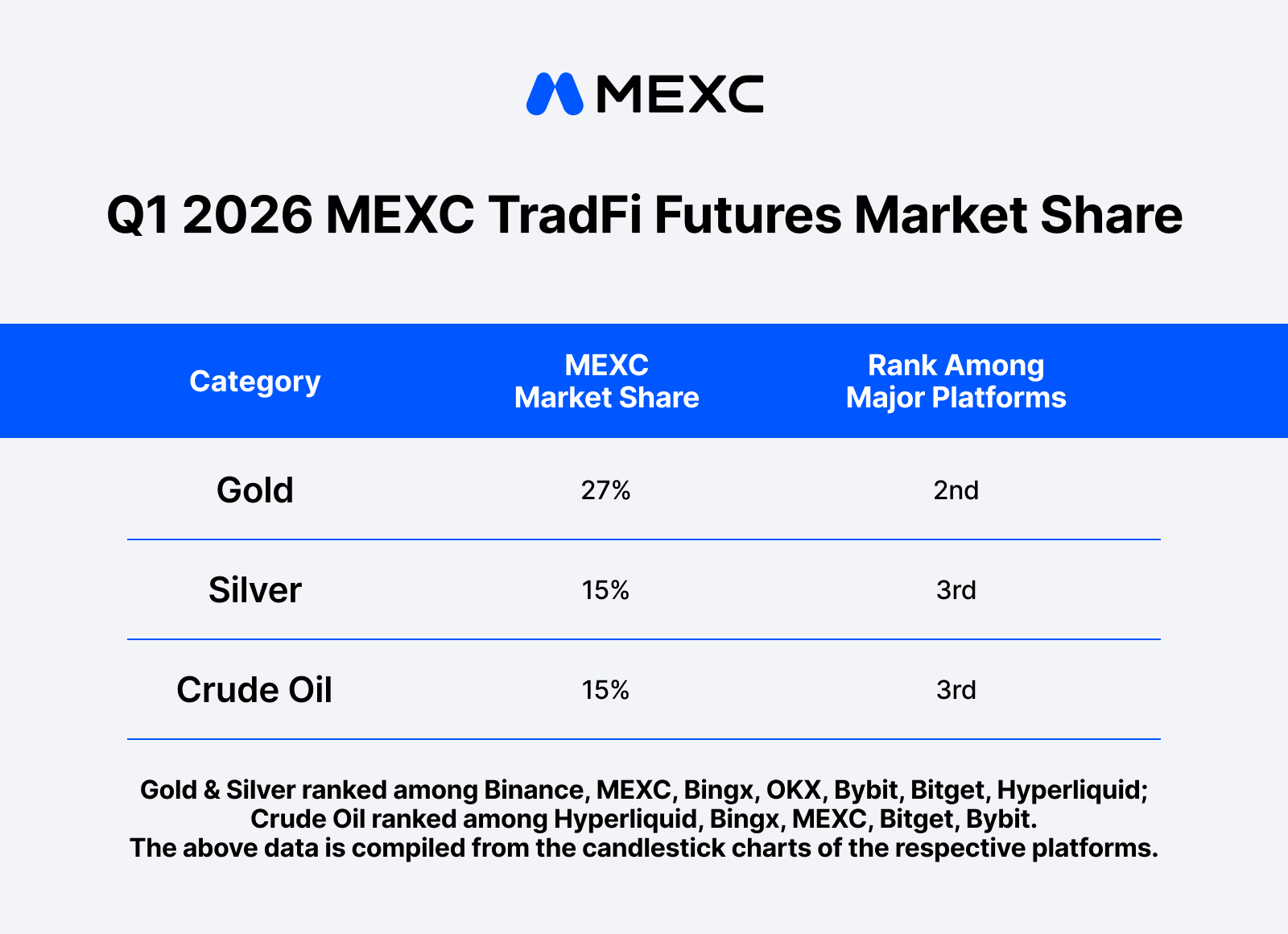
In Q1, MEXC’s gold futures captured a 27.4% global market share, firmly holding second place industry-wide. In February, market share reached 30.3%, narrowing the gap with the top-ranked platform to just 4 percentage points. Silver market share reached 14.6%, with a month-over-month gain of over 6 percentage points in March alone, which is the fastest growth rate among comparable platforms.
Energy has emerged as MEXC’s most distinctive competitive advantage. Just two months after launch, USOIL (WTI) and UKOIL (Brent) together captured a 15.3% market share in Q1, ranking third globally. Notably, most leading platforms record near-zero volume in crude oil derivatives, while MEXC is one of the few platforms offering both WTI and Brent perpetual futures simultaneously, establishing a clear first-mover advantage in a category that remains in its early stages.
IV. Liquidity Depth Leadership: Lowest Execution Costs in Extreme Market Conditions
Behind Q1’s sustained volume breakout, market conditions served as the catalyst, but order book depth was the true foundation for absorbing large-scale trades. In extreme market environments, platforms with insufficient depth are prone to slippage spikes and difficulty executing large orders. MEXC TradFi’s industry-leading order book depth enabled stable, efficient execution even during the most volatile conditions, allowing users to complete every order at a lower true cost. This is the core structural advantage driving MEXC TradFi Futures’ sustained volume growth.
Order book depth is the single biggest driver of execution cost for large trades. A deeper book means less market impact, tighter slippage, and ultimately a lower true cost per order. March 2026 live testing showed that MEXC’s gold order book depth at the top 5 levels ranked first among 7 major platforms, at 7.2x the median of competing platforms. In a standardized test using a 100,000 USDT market order, MEXC gold slippage came in 43% lower than the industry median, silver 66% lower, USOIL (WTI) 25% lower, and UKOIL (Brent) over 54% lower. The larger the trade size, the more significant the cumulative savings.
Data source: Live order book snapshots taken on March 23, 2026, covering 7 major platforms for gold and silver (MEXC, BingX, Binance, Hyperliquid, Bitget, Bybit, OKX) and 3 fully launched platforms for crude oil (MEXC, BingX, Hyperliquid). All figures are independently verifiable on each platform in real time.